
André Barbault. If your feed has spent the last month insisting that the world as we know it ends this July, take a breath. Someone very real said something very real about 2026 — but by the time it reached your newsfeed, it had picked up a name he never used, a shape he never described, and a doom he never predicted. Let’s sort it out properly.
Who he was
André Barbault was born October 1, 1921, in the little Yonne village of Champignelles — a blacksmith’s son who, at fifteen, was pointed toward planetary cycles by his older brother Armand and never really stopped. What followed wasn’t a tidy career so much as a lifelong appetite for cross-referencing everything: he wrote on psychoanalysis and astrology together (De la psychanalyse à l’astrologie, 1961), sat down with Carl Jung and Claude Lévi-Strauss for interviews, ran the Centre International d’Astrologie through the 1950s and ’60s, and in 1968 founded L’Astrologue, the journal he edited for decades. He was even an early adopter of computer-generated chart reports, partnering with the Astroflash company back in 1966. Thirty-odd books later, his reputation wasn’t built on flair — it was built on numbers. Which brings us to the actual tool everyone’s getting spectacularly wrong.
The index (not a basket — an index)
Barbault’s real contribution was the indice cyclique, the cyclic index, and it’s refreshingly unmystical: take the five outer planets — Jupiter, Saturn, Uranus, Neptune, Pluto, the slow old guard of the solar system — and for any given date, measure the angular distance between every possible pair of them. Ten pairs total (Jupiter–Saturn, Jupiter–Uranus, all the way through Neptune–Pluto). Add those ten numbers together and you get one figure. Plot that figure year over year and you get a wave. When the wave drops, the outer planets are bunching up together in the sky — and Barbault matched those troughs to history’s worst stretches: war, upheaval, collapse. When the wave climbs, the planets are spreading out toward oppositions, and those climbs matched periods of stability and expansion. No symbolism, no named shapes — just a running sum of angles, tracked like a market chart. That’s it. That’s the whole tool.
What he actually said about 2026
Run his index forward and 2026 lands on the rising side of the wave, not a new trough — which is the opposite of what’s trending. Here’s the real passage, in full (translated from the original French):
“The next conjunction in 2026 is centrally placed at the beginning of Aries and is in a triangular quartet of planets with a double sextile to a trine between Uranus in Gemini and Pluto in Aquarius. It is the most benefic configuration of the century and its interplanetary partnership will work for the best in a splendid relaunch of civilization. It contains a harmonious relationship between primordial polar opposites; the coming together of the external and the internal, rational and spiritual, mind and soul… human beings surpassing themselves while experiencing life on a higher level.”
That’s tied to the real Saturn–Neptune conjunction landing February 20, 2026 — not July at all. And Barbault even drew the chart: page 104 has the 2026 wheel, with Saturn and Neptune’s glyphs pointing to the same spot near 0° Aries, Uranus is marked on the cusp of Gemini, and Pluto in Aquarius, with two lines sketched inside the wheel connecting the three. That’s his “triangular quartet” — four planets, three points, because Saturn and Neptune share one of them.
What Barbault drew is not a Cradle. His diagram contains no opposition; it is simply a trine-sextile-sextile triangle linking Saturn–Neptune, Uranus, and Pluto around the February conjunction. Barbault never mentions an aspect pattern, and his predictions are based entirely on the index.

Barbault’s 2026-wheel, p. 104 of Planetary Cycles: Mundane Astrology
Saturn and Neptune conjoined near 0° Aries, Uranus on the cusp of Gemini,
Pluto in Aquarius
Now — about that “basket”
Here’s the one place where the pop-astrology version and the real astrology overlap — people are just muddling and misnaming the tool.
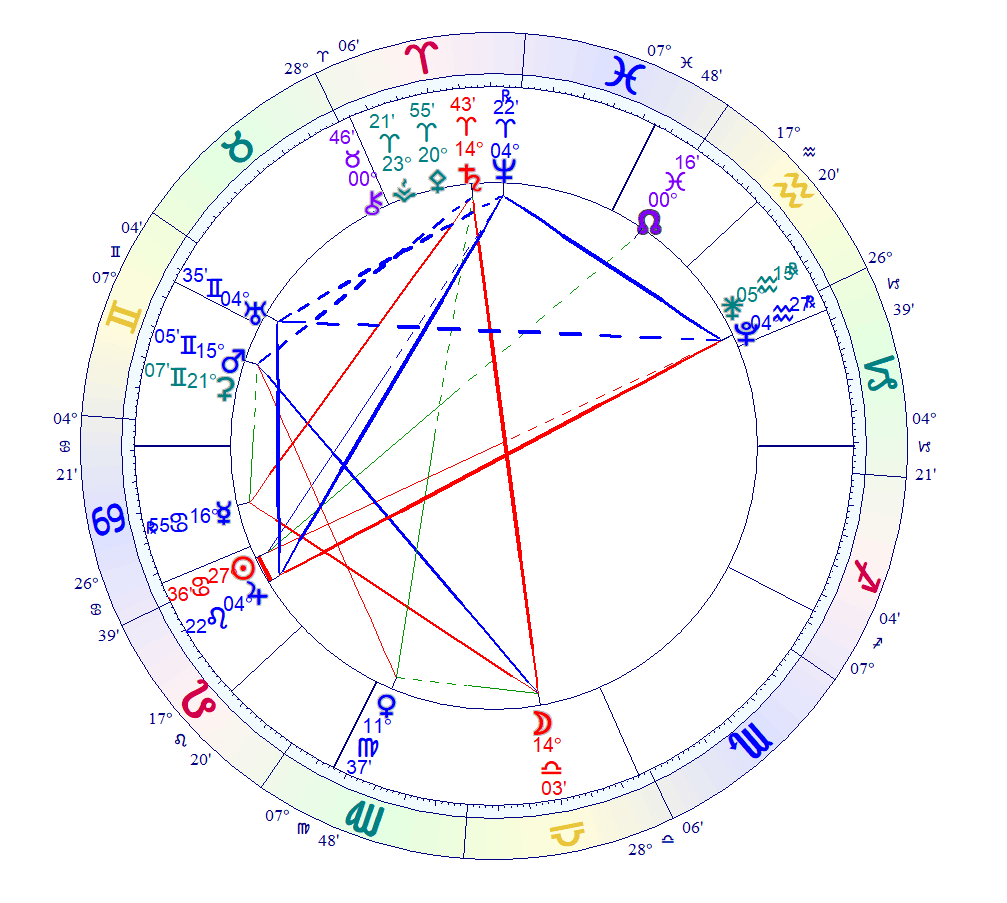
What’s causing the July stir is a genuine aspect pattern and it’s not new: in the Huber system (Bruno and Louise Huber’s astrological psychology), it is called a Huber Cradle. For this shape you need an opposition (Jupiter – Pluto) connected on one side by two sextiles (Uranus and Neptune). You can see how, with its container-like shape, why “basket” is such a tempting rebrand.
According to Joyce Hopewell in her book Aspect Patterns in Colour, “The cradle is … a very stable structure like a baby’s cradle it provides a safe refuge where we can snuggle down into the safety and comfort of the blue aspects. The red opposition is like a protective barrier under which the person can hide. There are two small talent triangles as parts of this figure so there’s talent here that can be tapped into and developed. The challenge here is to overcome the fear of falling out of the cradle into the opposite empty area of the chart. The mission here is to leave the security of the cradle and venture into the empty space using the creative expression of the inherent talents as indicated by the blue triangles.” In the case of 2026 that empty space is the Via Combusta, so, collectively, we are being asked to embark on a very big adventure!
The 2026 cradle (not basket)
The bottom line
So: two things happened this year — a data-supported uplifting prediction on how we will all work more happily together, and a Huber Cradle pattern that deserves its true name back. If you’ve got planets near 4° of the fixed signs, or 19° of the mutable signs, you’ll be feeling this one — but you’ll feel it as described by Joyce above. It is neither a basket nor has it anything to do with Baribault’s excellent predictive index.
Here is the part worth holding onto. Barbault wasn’t a channeler working off “vibes” — he was a numbers man, running the same index year after year, flagging many key historical events, not just the pandemic years, well ahead of when they landed. So, when that same index, run the with the same rigour, tells us 2026 is the rising side of the wave — a “splendid relaunch of civilization” — we can lean into that good news, and feel some badly-needed hope. But Barbault would tell you that the old astrologers’ rule still applies: the stars impel, they do not compel. He handed us a favourable forecast, not a guarantee. What we do with that opening — the work of building the relaunch he saw coming — is still entirely up to us. Let’s work together in good faith to make it happen.